Table of Contents
ToggleTrapeze table Pilates is Pilates done on a raised, padded table with a metal frame above it, where springs, bars, and straps give support or resistance. Because you lie, sit or kneel on a stable table, it suits beginners who want a supported start, as long as an instructor guides you. At Pilates360, trapeze table work is part of Studio Pilates, which is delivered as private or duet sessions across the Neutral Bay and St Leonards studios on Sydney’s Lower North Shore. The studio has been helping people move well since 2015. This guide explains what the trapeze table is, how it differs from the reformer, what the benefits may be, and how to try it as a beginner.
What Is the Trapeze Table in Pilates?
The trapeze table, also known as the Cadillac, is one of the classic pieces of Pilates equipment. It has a flat padded table at the bottom and a frame above it. Springs, bars, and straps attach to the frame, so your arms and legs can push against resistance or be supported by it while your body stays still on the table.
That combination of a stable base and adjustable springs is what makes it so versatile. An instructor can use it for strength work, for stretching, or for gentle supported movements, depending on what you need.
Trapeze Table vs Reformer: What’s the Difference?
| Trapeze table | Reformer | |
| Base | Fixed padded table | Sliding carriage on a frame |
| How resistance works | Springs attached to the frame above, pushed or pulled with bars and straps | Springs attached to the carriage, which you push and pull |
| What it feels like | Supported and stable | Moving and dynamic |
| At the studio | Part of Studio Pilates (private or duet) | Group classes capped at 9, plus private sessions |
| Good for | Supported strength and stretching with close guidance | Flowing full-body work in a class setting |
Many people use both. The reformer is usually the first stop for group classes, while the trapeze table is often used in smaller, more individual sessions.
Pilates Equipment at a Glance
If you are wondering what equipment you need for Pilates, the answer is none to start with, because the studio provides it. These are the main pieces you may come across:
- Mat: floor-based work using your body weight, sometimes with small props.
- Reformer: a sliding carriage with springs, straps, and a footbar.
- Trapeze table: a padded table with an overhead frame, springs, bars and straps.
- Pilates chair: a small apparatus with a pedal and springs for standing and seated work.
- Ladder barrel and arc: curved pieces that support the spine for stretching and mobility.
The studio’s Studio Pilates sessions use a variety of these pieces, including the chair, trapeze table, ladder barrel, arc, and reformer.
Benefits of Trapeze Table Pilates
Results vary from person to person, and the trapeze table is best seen as a supportive form of exercise rather than a treatment. Commonly mentioned benefits include:
- Supported positions: Lying on a stable table can feel reassuring if you are new to Pilates or unsure about your balance.
- Adjustable resistance: Springs can help a movement or make it harder, so the same exercise can be adjusted for you.
- Stretching and mobility: The frame and straps allow supported stretches that can be hard to do on the floor.
- Strength and core control: Pushing and pulling against springs works the arms, legs, and core with control.
- Personalised work: Because trapeze table sessions are usually one-on-one or duet, the instructor can tailor each exercise to you.
Is Trapeze Table Pilates Good for Beginners?
Yes, as long as an instructor guides you. The table is stable, and the springs can be adjusted, so many beginners find it easier to understand how a movement should feel. A private or duet Studio Pilates session is a good way in, because the instructor can teach the basics one-on-one and adjust exercises as you go.
Tell your instructor about any injuries, osteoporosis, joint replacements, balance concerns, or pregnancy, and check with your doctor or physiotherapist first if you have a health condition.
What Beginners Might Do on the Trapeze Table
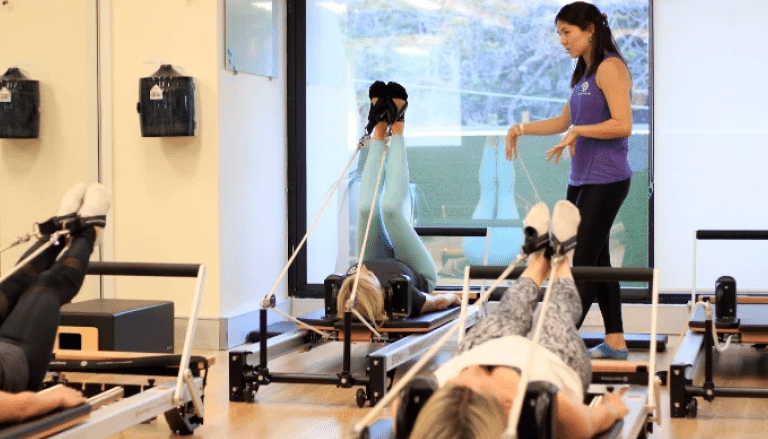
Your instructor chooses the exercises, so these are examples only. Beginners are often introduced to movements using the leg springs or arm springs, where you lie on the table and move your legs or arms against light spring resistance. Others use the bars on the frame, such as a roll-down or push-through bar, to work on spinal mobility and shoulder and arm control. Springs can be set lighter to support a movement or heavier to challenge it, and positions can be changed if something does not feel right.
The aim in early sessions is usually to learn how the equipment feels and how to move with control, not to work hard. If you have a particular concern, such as a sore back or tight hips, tell the instructor so they can choose and adjust exercises around it.
Who Might Prefer Trapeze Table Work?
- People who want one-on-one guidance: Trapeze table sessions are usually private or duet, so the instructor’s attention is on you.
- People who like a stable, supported start: Lying on a fixed table feels different from the moving carriage of a reformer.
- Anyone who wants supported stretching: The frame and straps allow stretches that can be hard to do on the floor.
- People returning to movement after a break: With clearance from your doctor or physiotherapist, the instructor can adjust the session to where you are now.
- People who like variety: It is a good complement to reformer or mat classes if you want to work in a different way.
If you prefer a social class with a group, a small group reformer or mat class may be the better first step, and you can add trapeze table work later.
Common Mistakes to Avoid
- Expecting a group class: Trapeze table work is usually part of private or duet sessions, so check how a session is delivered when you book.
- Not sharing your health history: The instructor can only adjust the session if they know about injuries, osteoporosis, joint replacements, or pregnancy.
- Assuming it is only for injuries: Many people use it simply for supported strength and stretching.
- Comparing it with the reformer: They feel different, and neither is better in every way.
- Rushing on and off the table: Take the instructor’s guidance on getting on and off safely, particularly as the frame sits above you.
What to Expect in Your First Session
- A conversation: The instructor asks about your goals, injuries and experience.
- Setup: They explain the equipment and help you onto the table safely.
- Gentle starter movements: You work through simple movements for the legs, arms and spine, with springs set to suit you.
- Adjustments: The instructor changes the springs, positions and range as you go.
- A cool-down and plan: You finish with a stretch and talk through whether to continue with private or duet sessions, or add group classes.
Wear close-fitting activewear and grip socks.
Where to Try Trapeze Table Pilates in Sydney
Pilates360 offers Studio Pilates in Neutral Bay and St Leonards, using equipment that includes the trapeze table. [CONFIRM which studio or studios have a trapeze table before publishing, and remove the other location from this section if needed.] Studio sessions are available Monday to Sunday and are booked by email at info@pilates360.com.au. You can also phone the Neutral Bay studio on 0499 283 490 or the St Leonards studio on 0499 283 499.
If you want to start with one-on-one guidance, ask about a private or duet Studio Pilates session. New clients also get a short consultation, online or by phone, before their first session.
Frequently Asked Questions
What is trapeze table Pilates?
Trapeze table Pilates is Pilates done on a padded table with an overhead frame, springs, bars and straps that provide support or resistance, with an instructor guiding each movement.
What is the difference between a trapeze table and a reformer?
The trapeze table has a fixed table with springs attached to the frame above, while the reformer has a sliding carriage with springs attached to it. The trapeze table feels more supported, and the reformer feels more dynamic.
Is trapeze table Pilates good for beginners?
Yes, with an instructor guiding you. The stable table and adjustable springs help many beginners understand how a movement should feel. A private or duet session is a good place to start.
Does Pilates360 offer trapeze table Pilates in Neutral Bay or St Leonards?
Pilates360’s Studio Pilates sessions use equipment that includes the trapeze table. Contact the team to confirm which studio to book for trapeze table work.
How do I book a Studio Pilates session?
Email info@pilates360.com.au, as studio sessions run Monday to Sunday and are booked by email. You can also phone Neutral Bay on 0499 283 490 or St Leonards on 0499 283 499.
What are the benefits of trapeze table Pilates?
Commonly mentioned benefits include supported positions, adjustable resistance, assisted stretching and personalised guidance. Results vary, and it is not a treatment for any condition.
What equipment is used in Pilates?
Common pieces include the mat, reformer, trapeze table, Pilates chair, ladder barrel and arc. The studio provides the equipment, so beginners need only comfortable clothes and grip socks.
Final Thoughts
The trapeze table gives you a stable, supported way to build strength and mobility with an instructor close by, which is why it works well for beginners who want a gentle start. If you are curious, the easiest step is a private or duet Studio Pilates session where the instructor explains each piece of equipment as you go.
View the Pilates360 timetable for group classes, or get in touch to book a Studio Pilates session at the Neutral Bay or St Leonards studio.